Full Unit History
ONE HUNDRED AND SEVENTY–FIRST OHIO VOLUNTEER INFANTRY – NATIONAL GUARD
Contributed By
ONE HUNDRED AND SEVENTY–FIRST OHIO VOLUNTEER INFANTRY – NATIONAL GUARD
This regiment of one hundred days’ men was mustered into service May 7, 1864. It was composed of seven companies of the Forty-first Ohio National guard from Trumbull county, and filled up from Portage, Geauga, and Lake counties. Rosters of companies A, B, C, D, G, H, and I, from Trumbull, will be found below. The regiment was organized and mustered into the service at Sandusky, Ohio, and was at once placed on guard and fatigue duty on Johnson’s island. It soon became noted for proficiency in drill and the neatness of its camp.
The One Hundred and Seventy-first regiment left Sandusky for Covington, Kentucky, on the 9th of June, and upon its arrival reported to General Hobson. Morgan and his guerilla followers were in the vicinity of Cynthiana. The railroad bridge across Kellar’s creek had been destroyed, and a Northern raid was anticipated. Considerable anxiety was felt at Covington, and there was even fear for the safety of Cincinnati. The One Hundred and Seventy-first regiment was placed on board cars and ordered to proceed to Kellar’s bridge, which was one mile from Cynthiana, and there await orders. Sentinels were placed on the cars and company officers charged to remain with their men. When the wrecked bridge which, was one mile from Cynthiana and sixty-five from Cincinnati, was reached, the regiment debarked, one company was sent out on sentinel duty and a “handful of men” detailed to serve as cavalrymen. The trains which had brought them were backed down the track and burned. Upon their arrival, the men of the One Hundred and Seventy-first regiment were supplied with ammunition, and then proceeded to eat their breakfast. We take from the Cincinnati Commercial the description of what followed:
Suddenly their quiet was disturbed by the rattle of musketry at Cynthiana, telling that hot work was getting on there between the One Hundred and Sixty-eighth Ohio and the rebel forces; and in a few minutes, to their great surprise, they ascertained that the fields around themselves were alive with rebel forces. A volley of musketry was poured in upon them by a squad of the enemy massed behind the fence of a clover field. From the first it was evident to General Hobson and Colonel Asper that their little force was completely surrounded, and from the disposition of the rebel troops it was evidently their design to conduct the fight in the bushwhacking style from the bush should our forces resist, which they probably did not believe would be the case, as they evidently were two to their one in the first of the fight.
Under these circumstances the regiment was divided into several squads, and sent to both east and west of the railroad, occupying such positions as they might secure. The rebels then appeared on every hand, displaying great activity in firing and considerable skill in keeping under cover from the fire of our troops. Throughout, the affair was as between sharpshooters, each man firing as he could obtain sight of the enemy. This continued about five hours, the loss on both sides being heavy. That of the rebels was much greater than our own, as much so proportionately, as their force was superior in numbers–we having 700 men, and they with their reinforcements, 2000. Against these odds the resistance made was desperate and determined. General Morgan who, when the fight here commenced, was at Cynthiana (the rebel force being commanded by General Getty), had supposed the Union force would surrender immediately. He considered his great odds, the greenness of our forces, and wondered with impatience how it occurred that the fighting continued. He had expected an immediate surrender, and sincerely desired it, as he did not wish to lose any of his men. He certainly had not expected this desperate resistance. He was astounded when at 9 o’clock A. M., a carrier dashed up to him at Cynthiana, and gave General Getty’s message: “Reinforcements, or give it up!” Several hundred troops were immediately sent down the pike, Morgan at their head, and with those the line was drawn still closer around the band until General Hobson was forced to accept the flag of truce and Morgan’s conditions of surrender, that the private property of the troops should be respected and that the officers should retain their side-arms. General Hobson, so all accounts agree in saying, had done all that could be done, himself displaying the greatest personal courage; and thus surrendering, he decided for the best.
After the surrender General Morgan directed that the officers should be allowed to retain their horses, but a rebel colonel had taken a fancy to Lieutenant-colonel Harmon’s horse, and being already in possession, insisted on keeping it, which he finally did, but gave Colonel Harmon another, though much inferior one. In this engagement the regiment lost 13 killed, and 54 wounded, 4 of whom subsequently died.
It was not for prisoners that the rebel raider made this attack on Union forces, but rather to remove opposition to his northward progress. To detain his captives as prisoners was impracticable, consequently he planned to dispose of them on the most advantageous terms. Morgan proposed to effect an exchange of prisoners, and with that view paroled General Hobson and staff, Colonel Asper, and Lieutenant-colonel Harmon, and Major Fowler, to go to the nearest point affording telegraph communication with General Burbridge (then commanding the district of Kentucky) under escort of three rebel officers. It was understood that if an exchange could not be allowed they should return, as soon as possible. Falmouth was reached June 12th, but before that time General Burbridge had pressed Morgan so closely that the later was compelled to parole his prisoners, who made their way to Augusta, whence they were taken on boats to Covington, and from there to Camp Dennison, Ohio. General Burbridge replied to General Hobson’s communication concerning an exchange of prisoners, with an order to General Hobson and staff to report to Lexington, Kentucky for duty, and also that his escort of rebel officers should be taken with him as prisoners of war; the other Ohio officers were ordered to Cincinnati. The One Hundred and Seventy-first was transferred to Camp Dennison to its old camp on Johnson’s island, in Lake Erie, but being paroled no duties were required till the War department declared the parole invalid, when the regiment was again equipped and placed on duty. It remained on Johnson’s island till the expiration of its term of service, where it was mustered out August 20, 1864. Reid says of the encounter with Morgan June 9th:
The results of the fight at Kellar’s bridge was greater than they at first appear to be. Morgan had planned his raid into Kentucky for the purpose of obtaining recruits, horses, and money, intending at the same time to sweep down the Licking valley to capture the small garrisons on the route in detail, and, if possible, to ride into Covington at Kellar’s bridge. He was delayed twenty-four hours and General Burbridge was enabled to meet him. The citizens of Falmouth, Kentucky, held a meeting and thanked General Hobson and the officers and men under him for the gallant manner in which they defended the valley from invasion; the citizens of Covington also thanked General Hobson, Colonel Asper, and the men in their command for the protection they had afforded the city.
And the Cincinnati Gazette said:
There is little doubt that the stubborn resistance of the One Hundred and Seventy-first saved Cincinnati from visitation. After the capture General Hobson, in a letter to Colonel Asper, expressed his entire satisfaction with the conduct of the One Hundred and Seventy-first, and General Heintzelman and Governor Brough both declared to Colonel Asper personally their gratification at the bravery and courage displayed by the regiment.
COMPANY D
Commissioned Officers [3]
Captain Evan Morris
First Lieutenant Austin W. Wilson
Second Lieutenant John Sampson
Non-Commissioned Officers [16]
Sergeant Robert Strawhan
Sergeant Charles Goodwin
Sergeant R. L. Walker
Sergeant S. H. McCartney
Sergeant James G. Jones
Corporal George Phillips
Corporal Daniel E. Moyer
Corporal Morris Theopholis
Corporal Joseph A. Osborn
Corporal John H. McKean
Corporal Aaron H. Westlake
Corporal Edward Powers
Corporal Freeman Reapsmeur
Musician Lauriston L. Miller
Musician George Todd
Wagoner Samuel Esgar
Privates [64]
A. A. Adams, Homer S. Adams, Charles H. Adams, David Andrews, Joseph S. Bell, George H. Bowen, Richard Bowen, John Bodin, John Burgess, John Breese, Newton B. Carlton, John M. Cook, John L. Custord, Rosser Davis, Benjamin Davis, Edward Davis, Jacob Davis, William Davis, Ambrose Eckman, Evan J. Evans, Edward Evans, Zenas Evans, George B. Frazier, Fredrick Fatchell, George M. Frank, David Griffith, Harvey Gilbert, Hiram K. Goist, Nicholas H. Green, Talbot Gridley, John Harris, George Harper, Benjamin F. Hull, Amos S. Hood, John Jeffreys, William G. Jones, Thomas D. Jones, Jonathan Keefer, John B. Lewis, Lewis D. Lewis, John E. Lewis, Charles S. Miller, Ezra B. Miller, William W. Miller, Evan W. Morgan, Isaiah Morris, Andrew McCartney, Samuel Mansell, James D. Morris, Augustus Neal, John C. Nelson, William Perkins, James Parker, Joseph Rayen, George N. Rodgers, Thomas Reynolds, Robert Roberts, Theodore Richmond, John Shults, Simon Schopp, Robert Taylor, David Williams, Thomas Williams, John Woodbridge.
Source: History of Trumbull and Mahoning Counties (Cleveland, Ohio: H. Z. Williams & Bros., 1882), vol. 1, pp. 151–152. Access digital copies of volumes 1 and 2 at *********************** through a catalog search by title.
Family History
Created by Brian and requested by Tina Waldher
Evan J. Evans
- Birth
- 14 Dec 1833
Wales
- Death
- 18 Nov 1909 (aged 75)
Wilkeson, Pierce County, Washington, USA
- Burial
-
Wilkeson, Pierce County, Washington, USA Show Map GPS-Latitude: 47.113323, Longitude: -122.057243
- Memorial ID
-
Evan J. Evans — Pvt, Co. D "Trumbull Guards," 171st Ohio Volunteer Infantry (National Guard)
- Born 14 Dec 1833, Llanrhaiadr-ym-Mochnant, Wales. Died 18 Nov 1909, Wilkeson.
- 100-days regiment: mustered in 7 May 1864, out 20 Aug 1864. Company D also included his brother Edward B. Evans and brothers-in-law Robert G. Roberts and Benjamin Davis.
- Pension index (NARA T288): invalid claim filed 3 Apr 1894 (later notation 1907), application no. 1,157,122, certificate no. 909,017 (allowed); no widow's claim; card stamped DEAD.
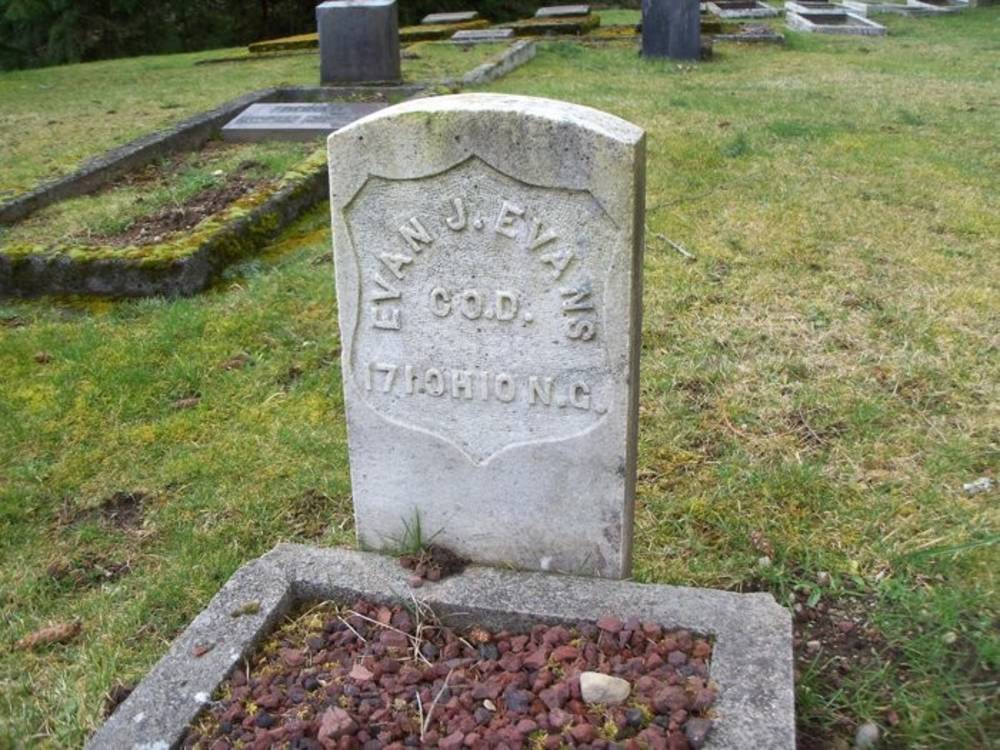
- Marker: upright white government headstone, shield reads "EVAN J. EVANS / CO. D. / 171 OHIO N.G." Block 21, plot 11, curbed plot with red lava rock. GPS 47.113323, -122.057243. Find a Grave #66933497.
-
Evan Evans was born 14 Dec 1833 in Pen-y-bont, Glantanat farm, Llanrhaiadr ym Mochnant, Montgomeryshire, Wales, the son of Evan B. Evans and Mary Jones Evans.
He was christened 24 Dec 1833 at St. Dogfan Parish Church, Llanrhaiadr-ym-Mochnant, Denbighshire, Wales.
St. Dogfan is the parish church of The Church In Wales (Anglican Church) in Llanrhaiadr ym Mochnant, also spelled Llarhaeadr ym Mochnant. The parish was divided between the counties of Montgomeryshire and Denbighshire, with the church physically residing in Denbigh. The Evans family lived in the Montgomery portion of the parish.
Bont is an abbreviation of Pen-y-Bont where Evan's older sister Mary stated that she was born. Glantanat is the name of a farm.
----------
1833 Baptism Register, Parish of Lanrhaiadr ym Mochnant, page 138, no. 1099
Baptisms solemnized in the Parish of Lanrhaiadr ym Mochnant in the County of Denbigh in the Year 1833. No. 1099 Baptized Decr 24th Evan son of Evan & Mary Evans, abode Bont Glantanat, farmer, ceremony performed by W. I. Williams, curate.
[source: Parish Record Collection at findmaypast.com, subscription website, free at local Family History Centers]
----------
Evan was the second of six known children born to Evan B. Evans and Mary Jones Evans:
* Mary Evans Roberts, born 22 Dec 1831, chr. 8 Jan 1832
* Evan J. Evans, born 14 Dec 1833, chr. 24 Dec 1833
* Sarah Evans, born 24 Aug 1836, chr. 4 Sep 1836
* Jane Evans Williams Howells Evans, born 10 Oct 1838
* Ann Evans, born abt 1840
* Edward B. Evans, 26 Jul 1842
The younger children were born at Caeshenkin or Caesiencyn farm, Llanrhaiadr, Montgomeryshire, Wales.
Evan emigrated to America in 1852 at the age of 18 with his parents, sisters Mary and Jane, and brother Edward.
He married Rachel Davis about 1854/1855 in or near Girard, Weathersfield Township, Trumbull County, Ohio.
They were the parents of eleven children: Isaac, Isiah, Evan Jr., Mary Jane (Roberts), George, John Davis, Rachel F. (Wells), Sarah, David, Violet (Gruell), and Charles Foster Evans.
Evan farmed with his father in Wales. Upon moving to America he worked as a collier or coal miner in Trumbull and Stark Counties, Ohio; Garfield and Pitkin Counties, Colorado; Pierce and King Counties, Washington
Evan was a veteran of the Civil War serving with the 171st Regiment, Company D, Ohio Volunteer Infantry National Guard, also known as the Trumbull Guards. The one hundred days regiment mustered in May 7, 1864, and mustered out August 20, 1864. The roster of Company D includes Evan J. Evans, his brother Edward [B.] Evans, brother-in-laws Robert [G.] Roberts and Benjamin Davis. [Learn more from their respective pension applications at the National Archives and Records Administration.] Evan's military headstone also validates his Civil War Union service.
Cemetery
Buried at Wilkeson Town Cemetery